The Kingdom of Champa: A Flourishing Civilization on the Shores of the East Sea (2nd Century – 1832)
I. Overview of Historical Development
1. Origins and Formation (2nd – 8th centuries):
- The Kingdom of Champa, known in ancient Chinese records as Lam Ap (Lin Yi), was established around 192 CE when local leader Khu Liên revolted against the Han dynasty and seized control of Tuong Lam district (modern-day Quang Nam–Quang Ngai). This marked the birth of an independent Cham polity.
- Initially, Champa was a confederation of coastal principalities in Central Vietnam, which gradually unified into a Hindu-influenced monarchy based on the Indianized model of divine kingship and Brahmanical (Hindu) worship.
First capital: Simhapura (Trà Kiệu, Quảng Nam)

2. Golden Age and Regional Engagement (9th – 14th centuries)
During this period, Champa reached the height of its power and cultural sophistication. Prominent capitals included:
- Indrapura (Đồng Dương, Quảng Nam) – a Mahayana Buddhist center (9th–10th centuries)
- Vijaya (Đo Ban, Binh Đinh) – a grand political and artistic capital (11th–1471)

Champa thrived on maritime trade, connecting with China, India, Srivijaya, Java, and the Arab world. It was a dominant force on the Eastern Sea (South China Sea) and frequently clashed with Đại Việt (Vietnam) to the north and the Khmer Empire to the south.
Major conflicts included:
- Wars with the Ly and Tran dynasties of Đai Viet
- Ongoing struggles with Khmer polities
3. Decline and Gradual Annexation (15th century – 1832)
- In 1471, Emperor Lê Thánh Tông of Đại Việt led a devastating campaign that destroyed Vijaya, resulting in over 40,000 Cham deaths and 60,000 captives, effectively ending Champa as a sovereign state.
- The remaining Cham retreated to Panduranga (present-day Ninh Thuận–Bình Thuận), which persisted as a semi-autonomous vassal state under the Nguyễn lord
- 1832: Emperor Minh Mạng of the Nguyễn dynasty officially abolished Cham royal authority and fully incorporated Panduranga into Đại Nam, marking the end of Champa’s political independence.
II. Religion and Belief Systems
1.Hinduism (Shaivism)
- Champa adopted Indian Hinduism early, with Shiva as the principal deity, along with Vishnu and Brahma.
- Cham kings often claimed divine status, taking names like Rudravarman, Indravarman, or Harivarman.
- Linga–Yoni symbols and sacred temples like Mỹ Sơn were central to religious life.
2.Buddhism
- Mahayana Buddhism flourished in the 9th–10th centuries, especially at Đồng Dương Monastery, which served as a major Buddhist complex.
- Later overshadowed by a revival of Hinduism from the 11th century onward.
3.Indigenous Cham Animism
- Pre-Hindu and pre-Islamic beliefs included worship of:
- Po Nagar (Mother Goddess)
- Deities of the mountains, rivers, rice, and nature
- These practices persisted and blended with Hindu rituals, and later influenced Vietnamese folk
4. Islam (Bani Islam)
- Introduced from the 15th century by Malay and Arab traders.
- 1. The Cham Bani community embraced a localized form of Islam, blending Quranic principles with ancestral worship and matriarchal customs.
- 2. Distinct from mainstream Sunni Islam, Cham Bani maintained hybrid rituals and preserved their identity through religious syncretism.
III. Cham Culture and Artistic Heritage
1. Architecture
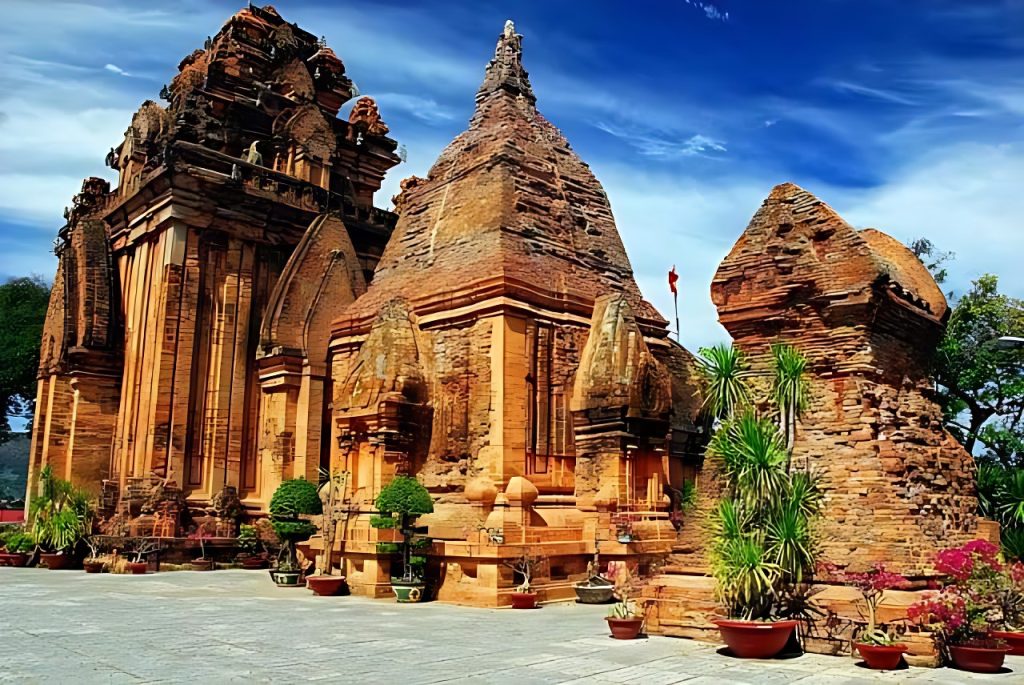
- Known for red brick temple-towers, using a unique dry masonry technique (without mortar).
- Major styles and sites include:
- Mi Son Sanctuary (Quảng Nam) – a UNESCO site and religious center (4th–9th centuries)
- Po Nagar Towers (Nha Trang) – dedicated to the goddess Po Nagar
- Thap Đoi (Twin Towers) and Thap Banh It, Thap Duong Long (Binh Đinh)
Cham masonry remains a mystery: seamless joints, water resistance, and unmatched longevity.
2. Sculpture
- Carved primarily in sandstone, showcasing sinuous lines and dynamic forms.
- Common themes:
- Deities (Shiva, Vishnu), celestial dancers (Apsaras), mythical animals (Makara, Garuda)
- Sacred objects like the Yoni–Linga and decorative motifs like lotus petals and spirals
- Cham art combines Indian and local Austronesian elements, resulting in a distinct aesthetic identity.
3. Costume and Decorative Arts
- Cham women wore long sarongs, shoulder-revealing tops, and ornate headscarves.
- Both genders adorned with jewelry (gold, silver, gemstones).
- Patterns were geometric, floral, or inspired by mythology.
IV. Cham Language and Script
- The Cham language belongs to the Austronesian family, related to Malay and Javanese.
- Written in Akhar Thrah, a script derived from Sanskrit and Pallava Brahmi.
- Cham inscriptions are found on stone steles, recording royal deeds, temple dedications, wars, and laws.
V. Society, Economy, and Civilization
1.Social Structure
- Champa was a divine monarchy, with Brahman priests holding significant influence.
- Society was hierarchical: royal elites, priests, artisans, farmers, and slaves.
- Evidence of matrilineal inheritance in parts of Cham society.
2. Economy
- A thriving maritime economy, trading in ivory, agarwood, spices, textiles, and ceramics.
- Agriculture focused on wet-rice cultivation, cotton growing, and animal husbandry.
- Skilled in textile weaving, metalwork, and ceramics.
VI. Legacy in Vietnam and Southeast Asia
- Champa was a unique Southeast Asian civilization that interacted with major regional powers: Dai Viet, Khmer, Srivijaya, and China.
- Its cultural legacy endures in:
- Cham towers and art (still preserved in central Vietnam)
- The Champa Museum of Sculpture in Đà Nẵng
- The living Cham communities in Ninh Thuận, Bình Thuận, and An Giang.
- Elements of Cham religion, architecture, and music have influenced Vietnamese culture, especially through the assimilation of Po Nagar into Thiên Y A Na in the Vietnamese Mother Goddess worship.
VII. Conclusion
Champa was not merely a vanished kingdom—it was a flourishing civilization that thrived for over 1,300 years along the central coast of modern Vietnam. Despite military defeat and political absorption in 1832, its religious traditions, artistic heritage, and cultural vitality continue to shape the region.
To understand Champa is to understand Southeast Asia’s maritime, religious, and cultural crossroads. Its ruins, languages, and spiritual legacies are a testament to the resilience of a people whose voices still echo in the wind-carved towers of Mỹ Sơn and in the songs of Cham elders by the Phan Rang River.